Attire, Talbiyah, Restrictions, and Common Errors
1. Dress Code for Ihram
-
For Male Pilgrims:
-
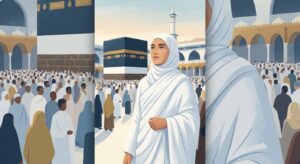
Consists of two unstitched white sheets/towels—one secured around the waist to cover the lower body (Izar) and the other draped over the shoulders (Rida).
-
Footwear should leave the ankles and top part of the foot exposed (such as simple sandals).
-
Idtiba’ (Exposing the Right Shoulder): This specific arrangement of the upper sheet is observed exclusively during the active rounds of Tawaf, not throughout the entire state of Ihram.

-
-
For Female Pilgrims:
-
Women may wear any modest, Islamically compliant everyday attire that covers the entire body properly.
-
Form-fitting face veils (Niqab) and stitched gloves are strictly prohibited during Ihram.
-
If non-mahram men are not nearby, the face remains uncovered. However, in crowded areas like the Holy Haram, women may drop a section of their headscarf over the face to maintain modesty without wearing a fitted Niqab.
-
2. Reciting the Talbiyah
The recitation of Talbiyah commences right after making the formal intention (Niyyah) for Ihram at or before the Meeqat boundary:
لَبَّيْكَ اللَّهُمَّ بِعُمْرَةٍ
(Labbayk Allahumma Bi-‘Umrah)
Translation: Here I am, O Allah, answering Your call to perform Umrah.
-
Conditional Intention (Stipulation / Ishtirat):
If a pilgrim anticipates illness or travel disruptions, they may add this supplication:
اللَّهُمَّ مَحِلِّي حَيْثُ حَبَسْتَنِي
(Allahumma mahilli haythu habastanee)
Translation: O Allah, my place of exiting Ihram shall be wherever You prevent me from continuing.
-
Continuous Talbiyah:
Pilgrims continue to repeat the general Talbiyah continuously until the commencement of Tawaf:
لَبَّيْكَ اللَّهُمَّ لَبَّيْكَ، لَبَّيْكَ لَا شَرِيكَ لَكَ لَبَّيْكَ
(Labbayk Allahumma labbayk, labbayka la sharika laka labbayk)
Translation: Here I am, O Allah, here I am. You have no partner, here I am…
3. Prohibitions & Restrictions During Ihram
Violating any of these Ihram restrictions necessitates an expiation (Fidyah):
-
Exclusive to Men:
-
Wearing tailored or stitched garments that conform to the body shape (e.g., shirts, trousers, underwear).
-
Direct covering of the head with fitted caps, turbans, or hoods.
-
-
Exclusive to Women:
-
Wearing stitched gloves on the hands.
-
Wearing a tailored face mask/Niqab tied around the face.
-
-
Forbidden for Both Men and Women:
-
Trimming, cutting, or pulling out hair from any part of the body.
-
Clipping or filing fingernails and toenails.
-
Applying perfumed scents, oils, or fragranced soaps to the body or clothing.
-
Engaging in marital intimacy or suggestive acts.
-
Conducting or agreeing to a marriage contract (Nikah).
-
4. Clarifications on Misconceptions & Common Errors
-
Passing Meeqat: Crossing the designated Meeqat boundary without making the intention for Ihram is impermissible.
-
Women’s Clothing Colors: Female pilgrims are not required to wear white; any dignified, non-attracting clothing is acceptable.
-
Ihram Accessories: Utilizing money belts, waist pouches, or sandals with stitched straps is fully permissible for securing belongings.
-
Menstruating Women: Women experiencing menses or post-natal bleeding must still make their intention for Ihram at the Meeqat and execute all rituals except Tawaf until pure.
-
Timing of Idtiba’: Men should avoid leaving the right shoulder uncovered prior to beginning Tawaf or after completing it.