
-
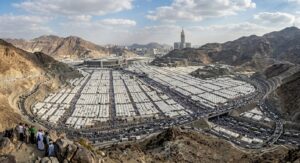
Location: Mina
-
Timeframe: From the afternoon through Fajr of the following day
Step 1: Entering the State of Ihram
Around midday on this date, pilgrims assume Ihram from their current place of residence and declare their commitment to begin the rites of Hajj.
Step 2: Preparations Prior to Reciting the Talbiyah
Before initiating the Talbiyah, pilgrims should complete the following personal hygiene and dress requirements:
-
Perform a full bath (ghusl), trim fingernails and toenails, trim the mustache, and remove pubic hair.
-
Men: Put on two clean, unstitched white sheets—one wrapped around the lower body (Izar) and the other draped over the upper body (Rida).
-
Women: Wear modest, standard clothing of choice. Face veils (niqab) and gloves must not be worn; however, women may draw a head covering or cloth over their faces if non-mahram men pass closely by.
Step 3: Guidelines for Qarin and Ifrad Pilgrims
Those performing Hajj as Qarin or Ifrad must not cut, trim, or shave their hair like Mutamatti pilgrims do, as they remain continuously in Ihram.
Step 4: Recommended Sunnah for Wearing Ihram
It is recommended (Sunnah) for male pilgrims to keep both shoulders covered while wearing the Ihram upper garment during this time.
Step 5: Declaring the Intention (Niyyah)
Pronounce the intention:
“Here I am, My Lord, I intend to perform Hajj.”
Step 6: Setting a Conditional Intention (If Applicable)
If a pilgrim anticipates any obstacle that might prevent them from finishing Hajj, they may state a condition:
“If I am detained by anything, my release from Ihram shall be where I am detained.”
Should an obstruction occur, the pilgrim may exit Ihram without incurring a penalty.
Step 7: Refraining from Prohibited Actions
Once the intention for Hajj has been declared, pilgrims must strictly avoid all restrictions and prohibitions associated with Ihram.
Step 8: Reciting the Talbiyah
Recite the Talbiyah frequently during the journey to Mina. Continue reciting it until the pelting of Jamarat Al-Aqaba begins on the 10th of Dhul-Hijja.
لَبَّيْكَ اللَّهُمَّ لَبَّيْكَ، لَبَّيْكَ لاَ شَرِيْكَ لَكَ لَبَّيْكَ، إِنَّ الْحَمْدَ وَالنِّعْمَةَ لَكَ وَالْمُلْكَ، لاَ شَرِيْكَ لَكَ
Step 9: Performing Prayers in Mina
Travel to Mina while keeping up the recitation of the Talbiyah. Upon arrival, perform Dhuhr, Asr, Maghrib, Isha, and Fajr prayers at their designated times. Do not combine prayers, but shorten the four-rakat prayers (Dhuhr, Asr, and Isha) to two rakats.
Step 10: Voluntary (Nawafil) Prayers
In accordance with the practice of the Prophet ﷺ while traveling, regular sunnah prayers are omitted, with the exception of the two optional rakats before Fajr and the Witr prayer following Isha.
Step 11: Daily Remembrance and Supplications
Pilgrims are encouraged to consistently recite the Prophet’s ﷺ sunnah supplications, particularly the morning, evening, and bedtime adhkar.
Step 12: Staying Overnight in Mina
Spend the entire night resting in Mina before proceeding to the next site the following morning.